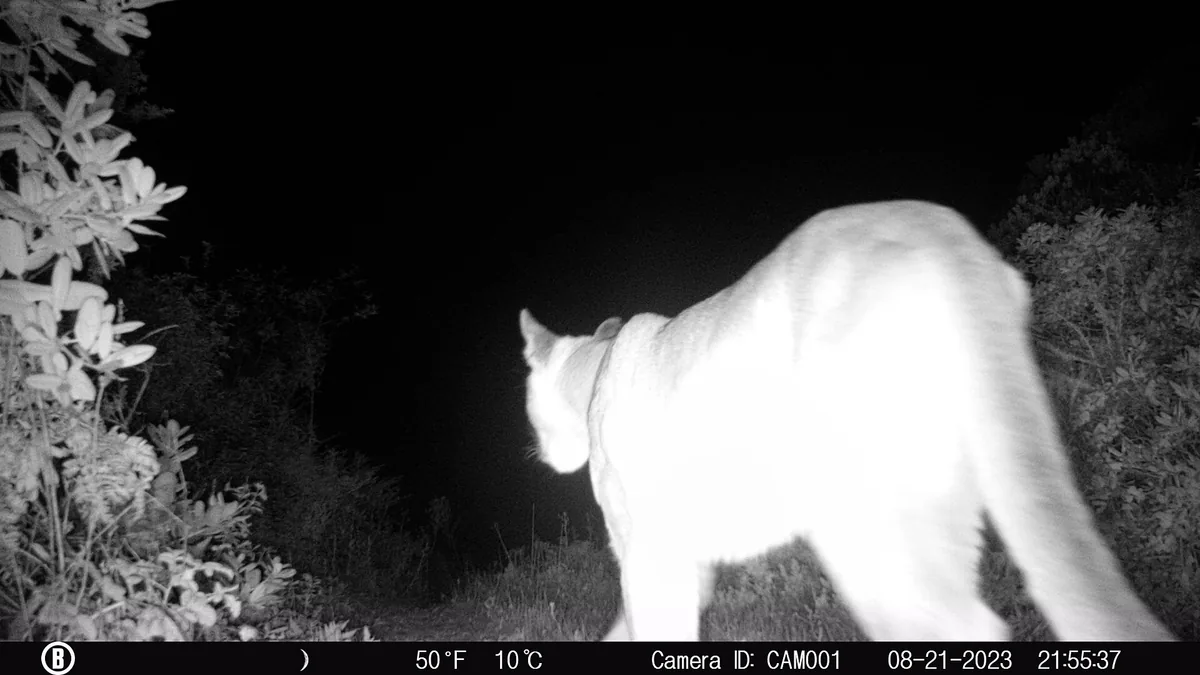
A trail camera that works all day and produces nothing but black frames after dark is one of the most common failures in this category — and one of the few where the cause is usually cheap to fix.
The causes below are ordered by how often they actually turn out to be the problem, not by how technical they sound. Work down the list. Most people stop at the first or second.
Weak batteries are the most common cause of missing night photos
This is the answer far more often than anything else, and it is counterintuitive enough that people rule it out early: a camera can have enough power to run all day and not enough to fire its infrared flash at night.
The IR array is the single largest current draw in the camera. Daytime photos need almost none of it. So a set of batteries that has fallen below the voltage the flash needs will produce a camera that appears to work perfectly — powers on, shows a healthy battery indicator, takes daylight images — and returns black frames after sunset.
What to do:
- Replace the batteries with a fresh set, even if the indicator shows charge remaining. The indicator reads voltage, not the current the flash needs.
- Use lithium, not alkaline. This is the single highest-value change on this page. Alkaline cells lose voltage steadily as they discharge and lose it much faster in cold. Lithium holds voltage nearly flat until nearly exhausted, which is exactly the characteristic an IR flash needs. In cold weather the difference is dramatic.
- Never mix old and new cells, or brands, or chemistries. The pack performs to its weakest member.
- Rechargeable NiMH cells nominally supply 1.2V against alkaline’s 1.5V. Some cameras handle this; many produce exactly this symptom on them.
If the camera is cellular, this is even more likely to be your answer, because transmitting already draws heavily on the same battery.
Check whether night mode or the flash has been switched off
Worth eliminating before you go further, because it costs nothing.
- Confirm the camera is in photo or video mode, not a time-lapse mode. Many time-lapse modes deliberately do not fire the flash, so they produce black frames overnight by design. This catches a lot of people.
- Check for a night-mode or IR setting that may be off or set to a minimum power level.
- Check any scheduling or time-window setting that could be restricting the camera to daylight hours.
- Verify the clock and the date. A camera with the wrong time can apply a day/night schedule at the wrong hours.
- If you cannot account for the settings, do a factory reset and configure it deliberately from scratch.
Clean the lens, the IR array, and the sensor window
Three separate windows on the front of the camera, and dirt on any of them affects night photos far more than daytime ones.
At night the camera is lit entirely by its own infrared flash. Anything on the front glass — dust, pollen, spider silk, water film, condensation — reflects that light straight back into the lens. The result is a white wash, a heavy haze, or a frame so blown out it reads as failure.
Clean all three with a soft dry cloth. Then check the seal and the desiccant if the housing has one, because internal condensation produces the same effect and returns every night until the moisture is dealt with.
Spiders deserve a specific mention. They are drawn to trail cameras, they build directly across the lens, and a web a centimeter from the glass is lit like a snowstorm by the IR array.
The subject may simply be beyond the flash range
Infrared flash range is much shorter than detection range, and the two get conflated constantly.
A camera can detect a warm body at a distance its flash cannot possibly illuminate. What you get is a triggered photo of darkness — the camera worked exactly as designed, and the animal was too far away to light.
Advertised flash range is measured under favorable conditions. In practice, expect meaningfully less, especially against dark ground, wet vegetation, or an animal with a dark coat, none of which reflect infrared well.
What to do: move the camera closer to where animals actually pass, or reposition so the trail crosses in front at a range the flash can reach. Something reflective in the background — a light-colored trunk, a bank — helps considerably.
An SD card fault can show up only at night
Night photos and video are larger files than daytime stills. A card that is failing, full, or too slow can write a daytime image successfully and fail on a larger one.
- Format the card in the camera, not on a computer. Camera-side formatting writes the file system the camera expects.
- Confirm the card is within the capacity the camera supports. Exceeding it causes erratic, hard-to-diagnose behavior.
- Check the physical write-protect switch on the side of a full-size SD card. It gets knocked easily.
- Try a different card. Cards fail gradually and often partially.
Night photos that are blurry rather than black are a different problem
If you are getting images but they are streaked or ghosted, the camera is working — this is motion blur, and it is a physical constraint rather than a fault.
At night the camera holds the shutter open longer to gather the light it has. A walking animal moves during that exposure. Nothing in the settings will fully eliminate it.
What helps: positioning the camera so animals cross the frame at an angle rather than moving directly across it, framing where animals pause rather than travel, and choosing a shorter video or a single still over burst mode, which forces still shorter exposures.
White glow, red glow, and no-glow flashes behave differently at night
If night images are consistently darker or shorter-range than you expected and everything above checks out, the flash type may simply be the explanation.
- White flash produces color night images at the cost of being obvious to animals and people.
- Low-glow infrared emits a faint visible red. Good range, mild visibility.
- No-glow infrared is effectively invisible — and delivers noticeably shorter effective range and grainier images than low-glow, for the same power. That is the trade you accepted when you bought it.
A no-glow camera producing dimmer, shorter-range night photos than a low-glow one is not faulty. It is doing what no-glow does.
When the camera is genuinely dead
If fresh lithium batteries, a factory reset, a clean lens, a newly formatted card and a closer position all fail to produce a night image, the IR array itself has likely failed. It is a common failure point, particularly after water ingress.
Test it in the dark: trigger the camera and look at the front. Low-glow arrays show a faint red. No-glow arrays show nothing visible — point a phone camera at it, as most phone sensors register infrared and will show the array lighting up. If nothing fires, the array is gone.
At that point, weigh a repair against replacement. On budget cameras the array is rarely economically repairable.
Common questions about trail cameras not taking night pictures
Why does my trail camera take daytime photos but not night photos?
Most often because battery voltage is high enough to run the camera but not to fire the infrared flash. Fit fresh lithium cells before investigating anything else.
Why are my night photos completely white instead of black?
Usually something close to the lens reflecting the IR flash — a spider web, dust, water film, or internal condensation. Clean all three front windows and check the desiccant.
Do lithium batteries really make a difference at night?
Yes, and this is the most reliable single fix on this page. Lithium holds voltage nearly flat until nearly exhausted, while alkaline sags progressively and much faster in cold. The IR flash is the highest-draw component in the camera, so it feels that sag first.
How far should a trail camera flash actually reach at night?
Less than the advertised figure, and less than the detection range. Advertised flash distance assumes favorable conditions. Dark ground, wet vegetation, and dark-coated animals all reduce it.
Should I format my SD card in the camera or on a computer?
In the camera, always. Computer formatting can produce a file system the camera handles inconsistently, and large night files are where that surfaces first.