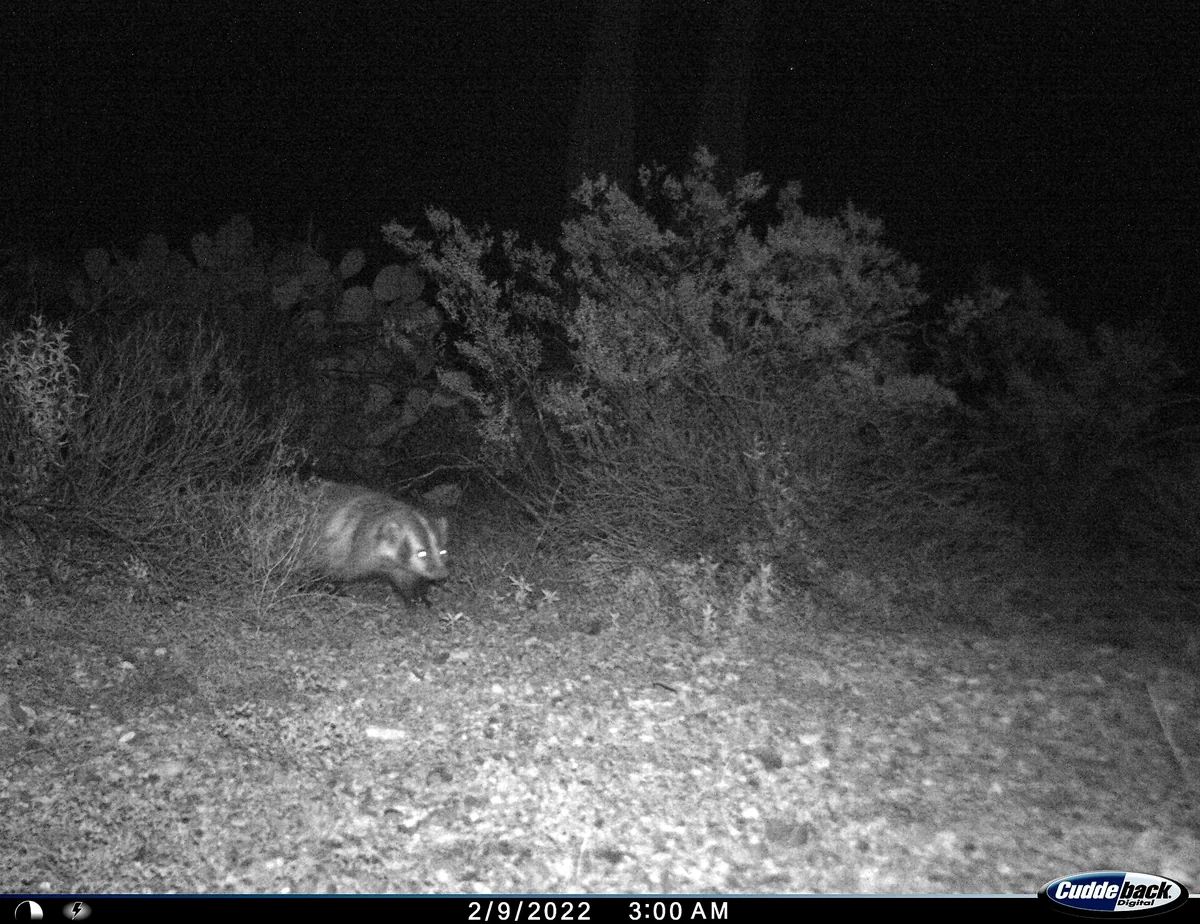
A cellular trail camera does everything an ordinary trail camera does — waits, detects motion, takes a photo — and then does one extra thing that changes how you use it entirely: it sends that photo to your phone over a mobile network, without you walking out to the camera.
That single addition is what you are paying for, and it is also where every complication comes from. Below is what actually happens inside the camera, what the data plan is really buying, and the conditions under which the whole arrangement quietly fails.
What happens inside a cellular trail camera when an animal walks past
The sequence is the same on every camera on the market, regardless of brand:
- The PIR sensor detects a change in infrared heat. Passive infrared sensors do not “see” anything. They register a difference between the temperature of a moving body and the background behind it. This matters more than most buyers realize, and we come back to it below.
- The camera wakes and takes a photo. The delay between detection and capture is the trigger speed.
- The image is written to the SD card. Every cellular camera is still an SD-card camera underneath. The card is the original, and it is usually a higher-resolution file than the one you receive.
- The camera powers up its cellular radio and connects to a tower. This is the expensive step, in both battery and time.
- A compressed copy is uploaded and appears in the manufacturer’s app.
- The radio powers down and the camera returns to standby.
Steps four and six are the ones that separate a cellular camera from a standard one, and they explain most of the behavior owners find surprising.
Why the photo on your phone looks worse than the one on the card
Almost every cellular camera sends a compressed thumbnail rather than the full-resolution image, because uploading full-size files over a mobile network would be slow and would consume the data allowance in days rather than months.
Most apps offer a way to request the original — usually called an HD request or full-image request — which tells the camera to upload the real file next time it wakes. On many plans that request costs extra, either in credits or in a higher tier.
The practical consequence: if you are judging a camera’s image quality by what arrives on your phone, you are judging the compression, not the camera. The file on the SD card is the one to look at.
What the SIM card in a cellular trail camera actually is
Cellular cameras contain a SIM, the same as a phone. There are three arrangements in the market and the difference matters:
- Locked to the manufacturer’s own plan. Most major brands do this. The SIM is pre-installed, tied to their service, and you buy data from them. You cannot shop for a better rate.
- Multi-carrier or auto-connect. The SIM can attach to whichever network is strongest at that location. This is a genuine advantage in patchy coverage, and it is worth more than most specification sheets suggest.
- Unlocked, bring your own SIM. Less common, mostly on cheaper imports. Flexible, but you are responsible for making it work.
One point that causes real confusion: the camera’s data plan is completely separate from your phone plan. Adding a camera to your existing mobile account is not usually possible, and the camera consumes its own allowance regardless of what your phone contract includes.
Why cellular trail cameras go through batteries so much faster
Transmitting is expensive. A cellular radio searching for a tower draws far more current than the sensor and the camera do while waiting, and the weaker the signal, the harder and longer it searches.
This produces a counterintuitive result that trips people up constantly: a camera in poor signal drains its batteries much faster than the same camera in good signal, because it spends longer with the radio powered up on every single upload attempt — including failed ones.
Three things follow from that:
- Battery life figures on the box assume favorable conditions, including good reception.
- Lithium cells hold voltage better in cold than alkalines and are worth the difference on a cellular camera specifically.
- Solar panels are more useful on cellular cameras than on SD-card ones, because the drain they are offsetting is larger.
What happens when a cellular trail camera has no signal
It keeps working as a normal trail camera. Detection, capture, and writing to the SD card all continue — those functions do not depend on the network. What stops is the delivery.
Most cameras queue undelivered images and attempt to send them when signal returns. Some will fill the queue and start discarding. The photos are still on the card either way, so nothing is lost permanently, but the whole reason you bought a cellular camera has stopped applying.
This is worth testing before you commit. Signal at the road is not signal at the camera — a hundred yards deeper into cover, or down into a creek bottom, is frequently the difference between working and not.
How detection range and trigger speed differ from the advertised figures
Because detection depends on a heat difference rather than on light, two things degrade it that are rarely on the box.
Air temperature. The smaller the gap between an animal’s body heat and the background, the harder detection becomes. TrailCamPro, who have tested trail cameras since 2003 with purpose-built equipment, put it plainly: a camera’s detection range “could be substantially greater on a 32 degree winter day compared to a 90 degree summer day.” A range printed on a box is a best case, not a rating.
Angle of approach. PIR sensors detect movement across their field far more readily than movement straight toward them. An animal walking directly at the camera can get remarkably close before it triggers.
Trigger speed has a similar gap. The published figure is measured under controlled conditions with fresh batteries; as voltage falls, real-world response slows.
None of this makes the specifications useless. It makes them a ceiling rather than an expectation, which is why we label every figure on this site as either independently measured or manufacturer-claimed. Our full method is on how we research and rate.
When a cellular trail camera is worth it, and when it is not
It is worth it when the trip to the camera is the problem. Remote land, a long drive, a property you visit rarely, or a spot where walking in to swap a card would disturb exactly the animals you are trying to watch. Removing those trips is the entire value proposition, and where it applies, it applies strongly.
It is not worth it when the camera is somewhere you already go. A camera behind the house on land you walk weekly gains you very little and costs a subscription indefinitely. A WiFi trail camera, which pulls images to your phone over your home network with no plan at all, covers that situation better and costs nothing to run.
The deciding number is rarely the camera price. Across three seasons the data plan frequently exceeds what the hardware cost, and plan structures differ enough between brands that the cheapest camera is often not the cheapest purchase.
Common questions about how cellular trail cameras work
Does a cellular trail camera still need an SD card?
Yes, on essentially every model. The card is where full-resolution images are stored; the upload is a compressed copy. Some cameras have a small amount of internal memory as well, but the card is still where the originals live.
Can I use my own phone plan or an existing SIM?
Usually not. Most cameras are locked to the manufacturer’s service, and the camera’s data is billed separately from your phone regardless.
Will a cellular camera work without any signal at all?
It will keep taking and storing photos on the card. It will not send them until it has coverage, at which point most models attempt to deliver the backlog.
Why do my cellular camera batteries die so much faster than expected?
Transmission is the largest single power draw, and weak signal makes it worse by extending how long the radio stays active on each attempt. Poor reception, cold weather, and alkaline batteries together will shorten runtime dramatically.
Is the image I get on my phone the full-quality photo?
No. It is compressed for transmission. Request the original through the app, or pull the SD card, if you need the real file.